It's the question every cake buyer faces at some point: fondant or buttercream? This isn't just about frosting — it's a decision that affects how your cake looks, tastes, holds up during your event, and even how much it costs. Both options have passionate advocates, and honestly? Both are excellent choices. The key is understanding which one is right for your specific cake, event, and preferences.
At Cleveland Cake Boss, we work with both fondant and buttercream daily (and sometimes in the same cake!). After creating thousands of cakes in both mediums, we're uniquely positioned to give you an honest, comprehensive comparison. Let's break it all down.
What Exactly Is Fondant?
Fondant is a smooth, pliable sugar dough that's rolled out into thin sheets and draped over cakes. Made primarily from sugar, water, gelatin, and glycerin, it creates a perfectly smooth, porcelain-like finish that's the hallmark of many elaborate cake designs.
There are actually two types of fondant:
- Rolled fondant: The thick, dough-like variety used to cover cakes and create decorations. This is what most people mean when they say "fondant."
- Poured fondant: A thinner, liquid version used for coating petit fours and some pastries. Completely different product, though they share a name.
Modern fondant has come a long way from its early days. Today's premium fondant can taste genuinely good — with flavors like vanilla, chocolate, and even marshmallow. The mass-produced fondant from grocery store cakes that gave fondant a bad reputation is a completely different product from what professional bakers use.
What Exactly Is Buttercream?
Buttercream is a frosting made primarily from butter, sugar, and flavorings. But within the world of buttercream, there's remarkable variety:
American Buttercream
The simplest version: butter beaten with powdered sugar, vanilla, and a little cream. It's sweet, familiar, and what most people think of as "frosting." It's somewhat thick and very sweet, with a slightly grainy texture compared to other buttercreams.
Swiss Meringue Buttercream (SMB)
Made by heating egg whites and sugar, whipping to stiff peaks, then gradually incorporating butter. SMB is silky, light, and less sweet than American buttercream. It has a sophisticated flavor and a beautiful, smooth texture. This is the buttercream of choice for many professional bakers.
Italian Meringue Buttercream (IMB)
Similar to Swiss meringue but made by pouring hot sugar syrup into whipping egg whites. It's incredibly stable, silky, and the most refined of the buttercreams. Slightly more complex to make, but the results are exceptional.
French Buttercream
Made with egg yolks instead of whites, French buttercream is rich, yellow, and incredibly indulgent. It's the most flavorful but least common for cake decorating due to its softness.
Ermine (Flour) Buttercream
A cooked-flour frosting that's light, fluffy, and not too sweet. It has a unique, almost whipped-cream-like texture and was actually the original frosting for red velvet cake.
The Head-to-Head Comparison
Taste
Winner: Buttercream
Let's be honest: most people prefer the taste of buttercream. Swiss and Italian meringue buttercreams in particular offer incredible flavor versatility — they can be flavored with everything from vanilla and chocolate to lemon, espresso, lavender, caramel, and beyond. The buttery richness complements cake beautifully.
Fondant is sweet and somewhat bland on its own, though quality fondant has improved dramatically. Some people love it, many are neutral, and some actively dislike it. The good news? Many cake eaters simply peel off the fondant and eat the cake and filling underneath — which is totally fine!
Appearance
Winner: Fondant (for certain styles)
Fondant delivers a flawlessly smooth, almost airbrushed finish that's difficult to achieve with buttercream alone. It's the gold standard for:
- Sharp, geometric designs
- Sculpted and 3D cakes
- Intricate piping and detail work
- Cakes that need to look perfect from every angle
- Elaborate themed cakes
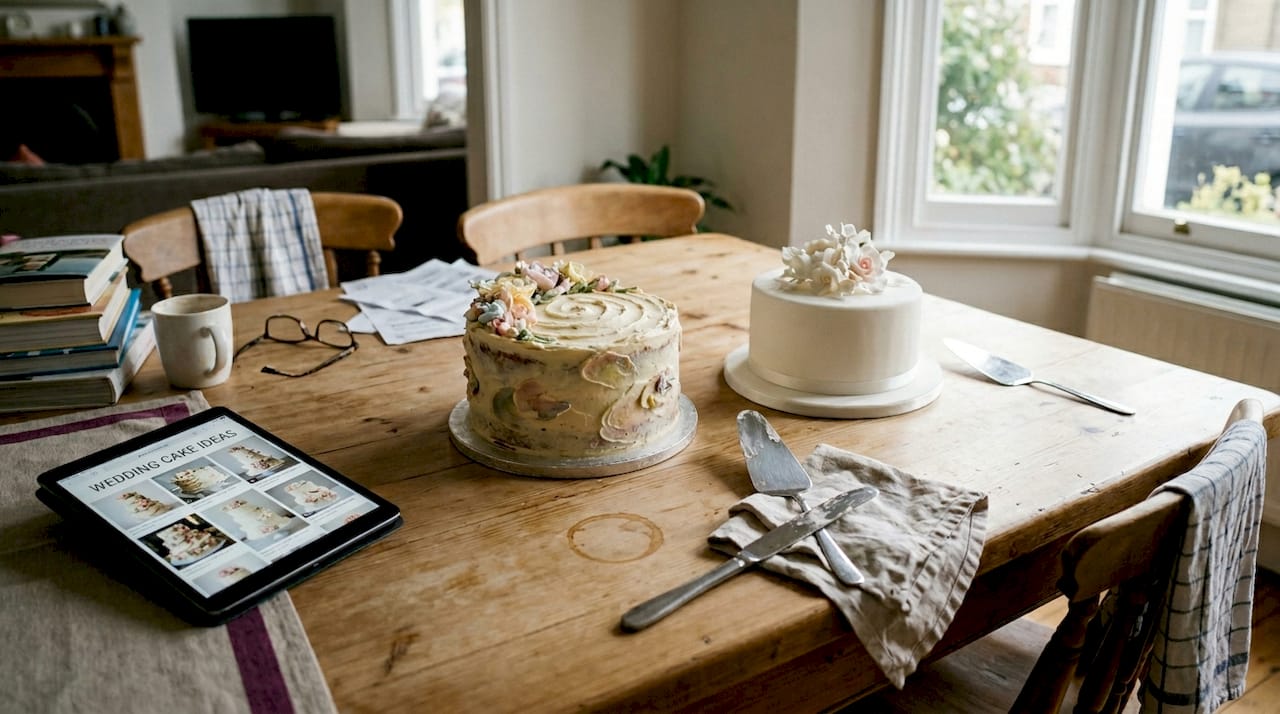
However, skilled buttercream artists can achieve remarkably smooth finishes using bench scrapers and hot spatulas. The "sharp edge" buttercream technique has become incredibly refined, closing the gap between the two finishes. And buttercream excels at creating beautiful textures — palette knife art, ombré effects, ruffles, and rosettes — that fondant can't easily replicate.
See both styles in action in our cake gallery to decide which aesthetic speaks to you.
Durability and Weather Resistance
Winner: Fondant
Fondant acts like a protective shell around the cake, sealing in moisture and providing structural support. This makes it superior for:
- Outdoor events where heat is a factor
- Events where the cake needs to be displayed for extended periods
- Cakes that need to travel long distances
- Stacked or tiered designs where structural integrity is critical
Buttercream is temperature-sensitive — it softens and can even melt in warm conditions. In a Cleveland summer, this matters. Air-conditioned venues are fine, but outdoor events or warm reception spaces may require fondant or special precautions.
Cost
Winner: Buttercream (generally)
Fondant cakes typically cost more because:
- Fondant itself is an additional material cost
- The preparation is more labor-intensive (rolling, draping, smoothing, trimming)
- Fondant decorations (bows, flowers, figures) are time-consuming to handcraft
A beautifully frosted buttercream cake can be equally stunning at a lower price point. That said, some buttercream techniques (like elaborate palette knife art or bas-relief sculpting) can be equally labor-intensive.
Versatility
Winner: Tie
Fondant excels at structural and sculptural work, sharp edges, and perfectly smooth surfaces. Buttercream excels at texture, flavor variety, and approachable elegance. Both can be colored, painted, and combined with various decorative elements.
The Best of Both Worlds: Combination Cakes
Here's a secret that many professional bakers know: you don't have to choose one or the other. Some of the most beautiful cakes we create use both:
- Buttercream frosted cake with fondant decorations: The cake is covered in delicious buttercream, while specific decorative elements (flowers, bows, figurines, borders) are crafted from fondant. You get great taste with intricate design details.
- Fondant covered cake with buttercream accents: A smooth fondant base with buttercream piping, rosettes, or floral details adds texture and dimension.
- Fondant exterior with buttercream underneath: A thin layer of buttercream between the cake and fondant adds flavor and helps the fondant adhere properly. When guests take a bite, they get buttercream flavor rather than plain fondant against cake.
When you request a consultation, ask about combination options. We're happy to show you samples and help you decide what combination gives you the look and taste you want.
Which Should You Choose? A Decision Guide
Choose fondant if:
- You want a perfectly smooth, polished finish
- Your design involves sculpting, 3D elements, or sharp geometric shapes
- Your event is outdoors or in a warm venue
- The cake needs to be displayed for several hours before serving
- You're after a specific themed design that requires structural detail
Choose buttercream if:
- Flavor is your top priority
- You prefer a more textured, organic look
- You're working with a tighter budget
- You love the look of palette knife art, ombré, or textured designs
- Your guests have expressed a preference for buttercream
Choose both if:
- You want intricate decorations but great taste
- You can't decide (the best of both worlds is always an option!)
- Your design has both smooth sections and textured details
Common Myths Debunked
"Fondant always tastes bad." Not true. Quality fondant from professional bakeries can taste great, especially flavored varieties. The chalky, waxy fondant on grocery store cakes is a completely different product.
"Buttercream can't look polished." Absolutely false. Skilled buttercream artists create finishes so smooth they rival fondant. Modern techniques and tools have revolutionized what's possible with buttercream.
"Fondant is too expensive." While fondant typically costs more, the difference isn't always as dramatic as people expect, especially for simpler fondant designs.
"You have to eat the fondant." Nope! It's perfectly acceptable to peel off fondant before eating. Think of it as gift wrapping for your cake.
At the end of the day, the best frosting choice is the one that serves your specific cake, your event, and your taste preferences. There's no universally "better" option — only the option that's best for you.
Still unsure? That's exactly what consultations are for. Reach out to us and we'll walk you through options, show you samples, and even let you taste both. Together, we'll find the perfect choice for your celebration.